Earth's Moon: Screening
The Semaphore digital twin now screens the predicted orbits of spacecraft around the Moon for close approaches.
A data problem
Around Earth, surveillance networks track objects on their own. No such network exists around the Moon. So the only way to foresee a close approach there is to screen operators’ predicted orbits against each other. NASA screens its spacecraft at Mars and the Moon this way. Its Jet Propulsion Laboratory (JPL) has done so since 2011. (NASA on JPL’s process; JPL’s 2024 update)
So a screen is only as good as the orbits that go into it. JPL notes that safety there rests on the orbits and uncertainties mission teams report themselves. Each operator predicts its own spacecraft’s orbit. A screen needs those predictions together, in one frame of reference and one time scale. The twin takes them in through its software interfaces, as Orbit Ephemeris Messages. That is one of the orbit formats of the Consultative Committee for Space Data Systems (CCSDS). (JPL’s 2024 update; CCSDS on orbits)
ANISE, an open-source library for time, reference frames, and orbits, puts the predictions in that frame and time scale. It keeps time with Hifitime, its time library. The twin reads each operator’s message with ANISE and measures every position from the Moon’s center. Our screening library also converts between Coordinated Universal Time and Barycentric Dynamical Time itself, for speed. Its tests hold that conversion within a microsecond of Hifitime’s conversion by the same model. (Nyx Space on ANISE; Nyx Space on Hifitime)
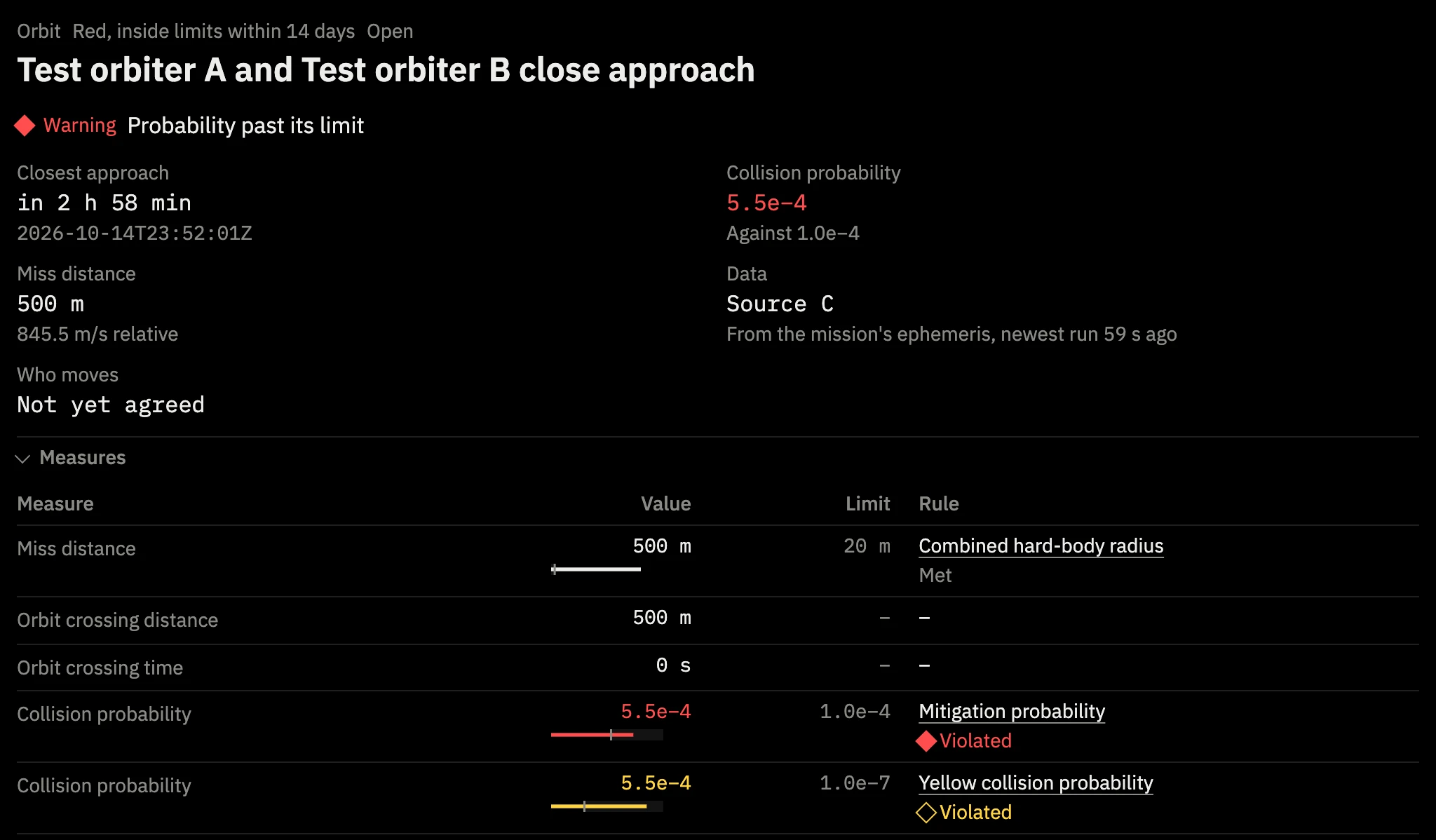
The twin screens each new orbit against every orbit its operator may read. It keeps each approach that comes inside a box around the new orbit’s spacecraft as a conflict. For each one, it records when the two are closest, how far apart, and how fast they pass. A later orbit from either operator can find the same approach again. The twin then adds that screen to the same conflict as a new run, and operators read the newest.
Horizons, a public solar system data service run by JPL, gives predicted orbits for several spacecraft around the Moon. The twin takes those in too. So an operator’s orbit is screened against those spacecraft as well, not only against orbits other operators publish. Horizons gives no uncertainty for them, so an approach to one carries no probability. Its predictions can also miss later maneuvers, so such an approach is for awareness, not an operational warning. (NASA JPL on Horizons; NASA JPL Horizons manual)
Where both orbits carry their uncertainty, the twin also computes the probability of a collision. It uses a 2D method. That method assumes the two pass each other in a straight line, with their uncertainty fixed while they pass. NASA’s Conjunction Assessment Risk Analysis (CARA) team found it often, but not always, accurate enough for satellites around Earth. When two spacecraft pass too slowly for its assumptions, the twin gives no probability and says why. (NASA CARA on probability)
The data problem is what we are building Semaphore to address. The Semaphore digital twin is where operators can publish their predicted orbits and read the orbits others share with them. Screening those orbits against each other is one of the things the twin does with that data. The more operators share, and the better their data, the better every screen gets. Starting in 2028, we plan to launch our own orbital and surface assets, and the twin takes in what they observe. Our goal is safer lunar operations and faster lunar development.
Why we built it
The number of spacecraft orbiting the Moon is growing. JPL has seen more missions beyond Earth in recent years. Close approaches have grown more frequent, especially in lunar orbit. JPL expects deep space to grow more crowded. Orbit matters to landers too. The Blue Ghost Mission 1 lander circled the Moon before it landed in 2025. Artemis astronauts board their lander in lunar orbit, descend to the surface, and return to orbit in it. (JPL’s 2024 update; NASA on Blue Ghost in orbit; NASA on its landing; NASA on Artemis landers)
How we checked it
The screening math is a library of its own, tested against answers from outside Semaphore. The largest test is a data set the U.S. Office of Space Commerce published in March 2026. It holds predicted orbits around Earth, with answer keys that list its close approaches. The Office offers it for self-assessment, not for certification or validation. We use it that way. The same code screens orbits around the Moon. (Office of Space Commerce on its release; Office of Space Commerce on the set)
We screened all 26,793 usable orbits in the set against each other over its whole span. On one cloud machine with eight processor cores, that takes seven to ten minutes. Our screen found 913,329 of the 913,330 close approaches in its key for a 10 km sphere. It found 283,593 of the 283,595 in its key for boxes. It also reported 5 approaches the first key does not list, and 9 the second does not. It placed 2 on the other side of a box’s face from the key. Every difference has a known cause, such as times the set rounds to the millisecond. We also compared probabilities where both give at least one in 100 million. For 99 approaches in 100, ours is within 0.25 percent of the key’s.
We also checked the probability against the test cases NASA CARA publishes with its analysis tools. On all eleven cases with a 2D answer, ours is within 0.1 percent of CARA’s. (NASA CARA’s tools)
What it covers
The screen covers spacecraft in lunar orbit. That already includes landers while they are in orbit, before they descend and after they climb back. The console shows these conflicts beside each asset and the rules that judge them. Next come a record of each conflict’s runs for analysis, screens of what-if orbits kept apart from operations, and a method for slow encounters. This is the start of the screening service we plan for lunar operators.